

Chapter 11: Same Issues, Different Size Vessels.
It is easier to build strong children than to repair broken men. ~ Frederick Douglass

Dropped in mid-journey? Walk Straight is best experienced from the beginning.

If I asked you to get on the floor right now, what shape would you make? Would it look like anyone in the picture above? Would you lean back, collapse forward, hold your legs? Can you sit on the floor comfortably, or are you the guy sitting on the couch or pulling up a chair?
There’s nothing I can do about it, it’s just the way I’m built,” say plenty of otherwise fit adults who can run, bike, or lift, but can’t sit on the floor comfortably. “ They give the usual suspects, hips, hamstrings, and back, top billing. But the why behind the tight remains a mystery, and they believe the fix is too.
Reverse engineering exposes the mystery by deconstructing our earliest habits.
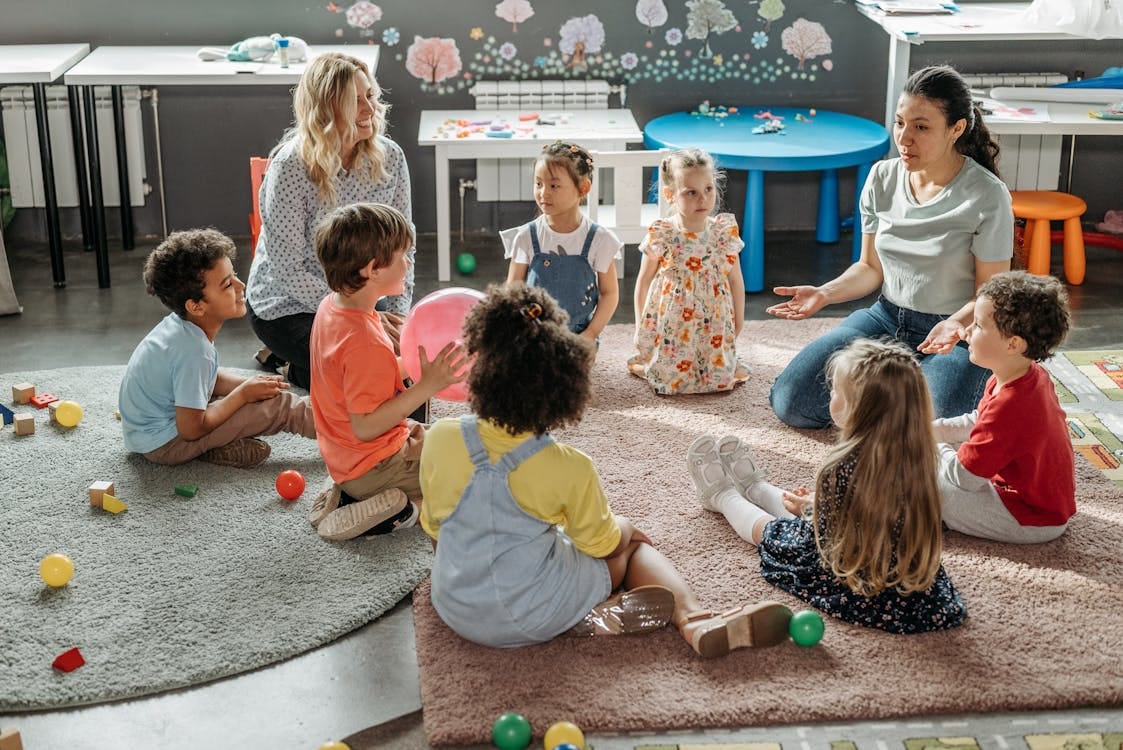
The image above is a familiar scene: preschoolers gathered in a circle on the floor. They are already adapting. At three, four, and five years old, most children’s hips are already working overtime to keep them upright. The relationship between the hip flexors, abdominals, thigh bones, and spine is already dictating how they sit. The shoulder girdle is still underdeveloped, so the head, arms, shoulders, spine, pelvis, and legs collapse into whichever tight muscles are in charge, leaving the rest to go wherever gravity takes them. That little body is already writing the blueprint it will follow for decades.
When you find yourself curling into the couch, sliding down into chairs, or hunching over your laptop, this is the adult version of preschool you.
Rather than recognizing the role this early imbalance plays, we brush it off. If the child says their body hurts, we call it growing pains. But like adults, children don’t arbitrarily grow out of physical dysfunction; they adapt to it. When pain fades, it’s usually not because the issue has been resolved, but habituated.
Think about it. While we’re busy discussing how bad sitting is for our adult bodies, we are simultaneously propping children into seated positions for extended periods as early as six months old. If you step back and look at that objectively, where’s the logic? Adults in the top picture, children in the bottom, same issues, different size vessels.
Sitting too early causes imbalance. Sitting in school for hours on end, year after year, compounds it. How we sit while we’re there makes everything worse. So let’s take a moment to remind ourselves just how our relationship with this bad boy develops.
Children sit in uniform chairs and desks, at shared tables or on the floor in whatever position is most comfortable and requires the least amount of effort.
In kindergarten, the height variation in a class can be 4 to 6 inches, further expanding throughout middle school and high school, where it grows to over a foot, with an 18-inch spread not uncommon; and yet, children will all typically use the same size desks and chairs.
Children and young adults on the smaller side of the spectrum sit with their feet dangling, the weight of the unsupported feet pulling on their lower spine and pelvis. They are forced to raise their shoulders and arms to clear the desktop. Meanwhile, tall children end up slumping, with shortened hips, hunched over, shoulders at their ears, and knees bent deeply, rising higher than their hips as they work to accommodate desks that are far too small. Adults would call it bad ergonomics and demand a fix. For kids, if their body hurts at school, again, just “growing pains.”
We know bad fits are a problem; most office and home workspaces now come with built-in adjustability. The one-size-fits-all model is long gone. We’ve even made room for “active” workstations, standing on the ground, balancing on a wobble board, pedaling under the desk, or walking miles on a treadmill while firing off emails. We didn’t do that because it looked cute in a catalog. We did it because it works. Creativity goes up. Productivity goes up. Our bodies complain less. It’s become a smart, cost-effective investment, the kind you don’t have to sell people on anymore.
The same reasoning applies to children. Arguably, even more so, because their bodies are in a constant state of growth and change becoming an adult body. Studies link regular movement during the school day to gains in learning, retention, behavior, and emotional well-being. For kids who struggle to sit still in traditional desks (often leading to disruption and discipline issues), chair designs with swinging foot bars or pedals allow for quiet movement, letting their bodies release energy without distracting others. There are win-wins everywhere.
So let’s fix this! Children attend school for the majority of the day, providing an opportunity to address their physical health in conjunction with teaching academics. We know physical health supports mental clarity, and COVID showed us we can adapt systems almost overnight. Wouldn’t it be extraordinary if we could create schools that support the optimal development of children’s bodies as well as their minds? Throw out the phones and bring in adjustable pedal desks.
Does it cost money to have tables and desks with adjustable legs? Yes. Does it cost money to offer active workstations to kids? Also yes. But the payoff? Healthier joints and spines, stronger attention spans, fewer discipline issues, more engaged classrooms, and down the road, fewer adults limping into orthopedic clinics. Add in the billions we already spend every year on joint and spine problems in both children and adults, plus the growing mental health and obesity crises, and you start to wonder why we’re hesitating. On a national level, ignoring it isn’t just shortsighted, it’s self-sabotage.
Let’s change the schools for the kids. And for the rest of us, “That’s just the way my body works” isn’t the end of the story; it’s the beginning. So, give it a go! Sit on the ground. What does it look like? Are you sitting up, leaning back? Need to hold your knees? Can you sit with your back vertical, legs outstretched? What are your feet doing? Whether you can or can’t, take note. These adaptations your body has made along the way aren’t destiny; they’re just patterns. And patterns can be changed. It’s just easier when we can see them for what they are.
If this made you go hmmm… and consider the effects of ill-fitting furniture, please consider liking, sharing, and subscribing! XxD
Sometimes, all it takes is a shift in perspective or a nugget of information considered in a new light to spark the ah-ha moment that changes everything! Subscribe for free to get a new chapter delivered to your inbox each week! XxD
Any observations or stories you’d like to share? Please drop down to the comments!
I struggle with oversized school bags on their backs! Never thought of the, now fortunately; brief ballet or gymnastics classes for our children
….although have been walking barefoot a lot more since the last chapter and it’s doing my back good, thanks @DeborahCampbell
Goodness! It seems so obvious when you put it like this. Office workers splurge on all sorts of ergonomic tools while we stuff our kids into whatever furniture has been in our schools for the last 50 years!